Introducing the LightCure Quality of Life Study

LightCure study with HAW Hamburg

The research team from the University of Applied Sciences in Hamburg, Germany invites hyperinsulinism (HI) families to take part in a study titled “Family-Centered Research on Quality of Life in Families with Congenital Hyperinsulinism: Light for double specificity and efficacy without burden: LightCure.” This study aims to develop a patient-reported outcome measure to assess health-related quality of life in patients with congenital HI and their caregivers, as well as shared decision-making materials. Your experience can help improve care for people living with HI.

The goal of the project is to create two helpful tools for people with HI, to make their daily life easier and help them get better care everywhere. The first tool is a questionnaire that lets children, teenagers, and adults with HI – and their families – share how the condition affects their daily life and health. The second tool is a simple manual guide between doctors, patients, and families to work together in making better choices about treatment.

Please click here to learn more about this study.

It includes information on why is it essential, especially for patients, as well as the different phases of the project, and what happens during each of these phases.

In addition to that link, you can also view an informational PDF in English here, with the same material presented in German here.

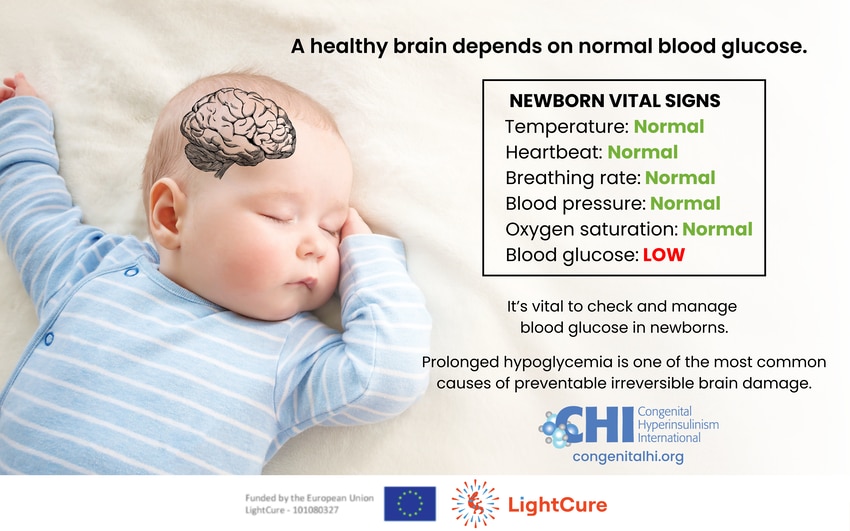
It’s vital to check and manage blood glucose in newborns

a healthy brain depends on normal blood glucose

Congenital hyperinsulinism (HI) is the most frequent cause of severe, persistent hypoglycemia (low blood sugar) in newborns. Untreated or improperly treated hypoglycemia can be dangerous because the brain relies on glucose as its primary source of energy. Without enough glucose, permanent brain damage can occur, potentially impacting a child’s development. The risk of brain damage is higher if HI is not diagnosed and treated quickly or if treatment does not work well at preventing ongoing hypoglycemia. However, with the right treatment, hypoglycemia can be managed, and brain damage can be avoided. Treatment options for people with HI are actively evolving through on-going clinical trials.

To learn more about hyperinsulinism and Hyperinsulinism Awareness Day, please visit this page on the Congenital Hyperinsulinism International website.

Hyperinsulinism Awareness Day, June 7, 2025

Press Release, as provided by Congenital Hyperinsulinism International:

Congenital Hyperinsulinism International masthead

Hyperinsulinism Awareness Day Will Be Observed Saturday, June 7

For Immediate Release: May 12, 2025

Glen Ridge, NJ – Congenital Hyperinsulinism International (CHI) is excited to announce that June 7, 2025 will be Hyperinsulinism Awareness Day. Congenital hyperinsulinism (HI) is the most frequent cause of severe, persistent hypoglycemia (low blood sugar) in newborns.

“Hyperinsulinism is something everyone should know about because the worst consequences of the condition are all preventable with timely recognition and management,” says Julie Raskin, CEO of CHI. “CHI raises global awareness of the condition and offers vital support to those affected and their families. No one should have to face HI alone.”

Untreated or improperly treated hypoglycemia can be dangerous because the brain relies on glucose as its primary source of energy. Without enough glucose, permanent brain damage can occur, potentially impacting a child’s development. The risk of brain damage is higher if HI is not diagnosed and treated quickly or if treatment does not work well at preventing ongoing hypoglycemia. However, with the right treatment, hypoglycemia can be managed, and brain damage can be avoided. Treatment options for people with HI are actively evolving through on-going clinical trials.

In most countries, Persistent HI has an incidence of up to 1:28,000 births. Some forms of HI are linked to a genetic defect and can persist throughout life; others will resolve more quickly and are considered transient. Transient cases are far more common, occurring as frequently as 1 in 1,200 births. Brain damage is a risk in both cases. CHI hopes that HI Awareness Day will create a broader knowledge of the condition, as well as better understanding of the need for prompt diagnosis and management by established protocols.

“In babies with HI, the pancreas secretes insulin in an uncontrolled way, even when blood glucose levels are low. These babies present at birth with severe hypoglycemia that can lead to irreversible brain damage. Therefore, recognizing the condition and treating it is of the greatest urgency,” says Diva De Leon, Director of the Hyperinsulinism Center and Chief of the Division of Endocrinology at the Children’s Hospital of Philadelphia. “In hospital maternity wards and pediatricians’ offices, glucose is a vital sign that must not be ignored.”

###

About CHI

CHI, a nonprofit 501(c)3, is a global organization dedicated to supporting children and adults born with HI. CHI is a leading source of funding for research for better treatments and cures, and the foremost advocate for increased awareness and better medical protocols for HI in order to reduce preventable brain damage and death from prolonged hypoglycemia.

Contact

For more information, contact Lily Barnett, CHI Communications Associate, at lbarnett@congenitalhi.org or 973-544-8372.

Funded by the European Union

“The LightCure Project,” presented by Professor Martin Gotthardt

Professor Martin Gotthardt of Radboud University Medical Centre in Nijmagen, The Netherlands, gave the following presentation at the 2024 Congenital Hyperinsulinism International Family Conference in Liverpool, UK.

The LightCure Consortium is developing a targeted photodynamic therapy, that one day could be a promising treatment for congenital hyperinsulinism (HI). This project is made possible by a grant of just over €8.2M from the European Union research arm Horizon Europe and encompasses CHI’s work to strengthen patient engagement and raise worldwide awareness of HI and its myriad challenges.

A LightCure on the Horizon

From a Press Release provided by Congenital Hyperinsulinism International (CHI)

A LightCure on the Horizon: With Congenital Hyperinsulinism International as Advocacy
Partner, European Scientists are Developing a Potential New Photodynamic Therapy
Treatment for Congenital Hyperinsulinism

Congenital Hyperinsulinism International (CHI) is excited to announce a new partnership for the
development of a promising investigational treatment for congenital hyperinsulinism (HI). HI is a life-threatening illness with few treatment options; complications include hypoglycemic brain injury with developmental disorders and epilepsy. The LightCure consortium’s hypothesis is that light can be used to target and eliminate improperly working pancreatic cells. This project is made possible by a grant of just over €8.2M from European Union research arm Horizon Europe that encompasses CHI’s work to strengthen patient engagement and raise worldwide awareness of HI and its myriad challenges.

“If this approach is successful, it would be an incredible breakthrough,” says Julie Raskin, CEO of CHI. “We love working side by side with scientists on this important project. By being included, there is a recognition of the important role the patient and caregiver community play in raising awareness of the consequences of late diagnosis and in developing patient-reported outcome measures, which are needed in the treatment development process.”

Read the full press release here.

How laser therapy prevents babies’ life-threatening disease

As reported by Innovation Origins:

One in 50,000 newborns suffers from congenital hyperinsulinism (CHI). This is a genetic disorder in which the insulin cells of the pancreas, called beta cells, secrete too much insulin. Excess insulin causes low plasma sugar (hypoglycemia) or low blood sugar. Low blood sugar can be hazardous because the brain needs a constant source of sugar. If the brain doesn’t get the sugar it needs, it can lead to seizures, brain damage, and possibly death. Laser light therapy is a new potential care path.

Read the full coverage here.

Prevent life-threatening low sugar in babies with laser light

LightCure develops targeted photodynamic therapy for rare disease

As reported by Radboud UMC:

With an European grant of eight million euro, an international consortium, coordinated by Radboudumc, will investigate whether congenital hyperinsulinism can be treated with an innovative light therapy.

“It is a frightening disease for babies and children, and it is very stressful as well for parents, family members and close acquaintances,” says Martin Gotthardt, professor of Experimental Nuclear Medicine at Radboudumc. He characterizes the rare condition congenital hyperinsulinism (CHI), in which beta cells in the pancreas secrete too much insulin. The result is too little sugar in the blood (a hypoglycemia, or hypo for short), which can cause sweating, shaking, headaches, hunger, dizziness, blurred vision and heart palpitations. If a hypo is not recognized in time – a major risk in babies who cannot tell what they are suffering from – there is even a risk of seizures, unconsciousness, permanent brain damage or death. Thus, 25 to 50 percent of babies with congenital CHI are diagnosed (too) late, leaving them with brain damage such as intellectual disability or cerebral palsy for the rest of their lives.

Read the full coverage here.